Frequently Asked Questions
Click any question to see the answer.
The Screen Balance Program is a structured online course for parents who are worried about how screens are affecting their child, now and in the future. It was built by Dr. Danny O'Rourke and Dr. Jennifer Tininenko, both clinical psychologists and both parents.
It gives you a clear picture of where your family actually stands, explains why screens have the hold they do, and then walks you through building a plan that fits your own child rather than a generic set of rules.
It is an educational course rather than a clinical service, and it is not a lecture about screen time limits. It is a working program built to help you change what happens at home.
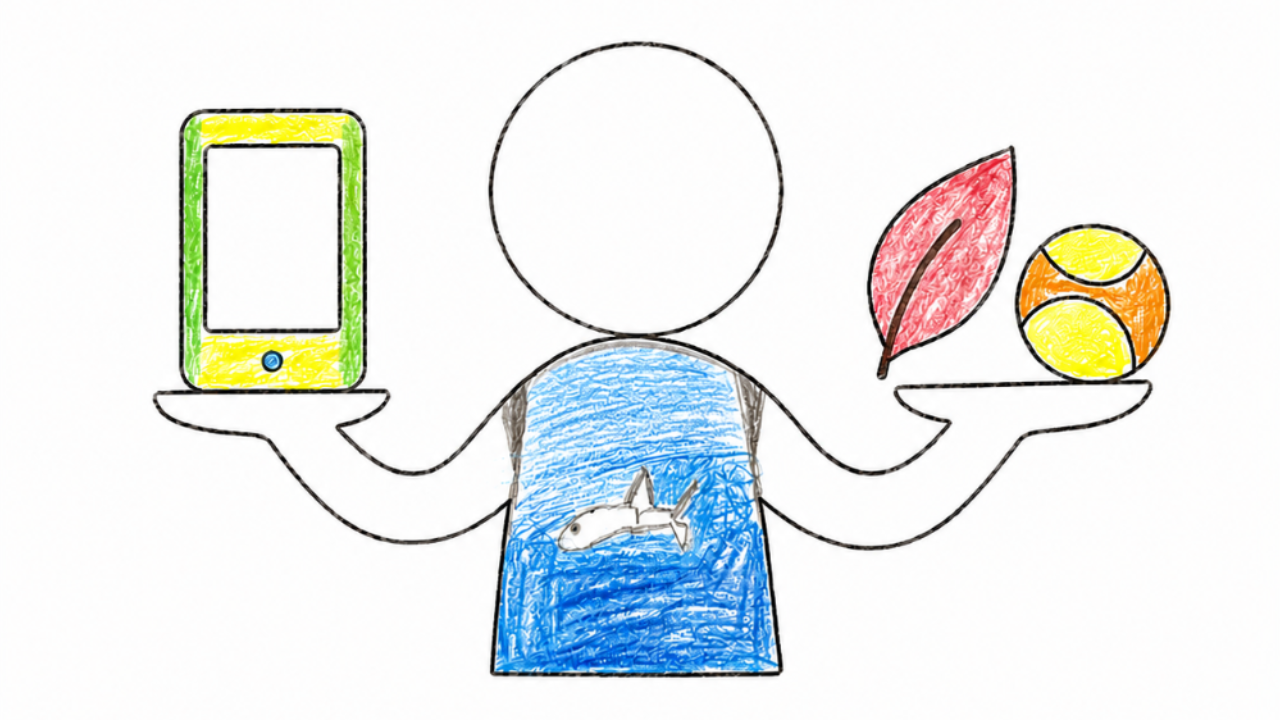
My (Danny O'Rourke) son did. He colored it in, and he was into drawing dolphins at the time, which is why the figure has one on his shirt.
It is not as professional as something a design studio would hand us, and we know that. He wanted to be famous and have his art online, so it stayed. It also shows what the program is about: a child weighing a tablet on one side against a leaf and a ball on the other.
Parents of children and teenagers who feel that screens have become too central to their child's life. You might be noticing:
- Daily arguments or meltdowns when screens are taken away
- Sleep that has deteriorated since screen use increased
- A child who used to have broad interests but now only wants to be on a device
- A growing sense that you have lost control of how screens fit into family life
The course works for a wide age range, from very young children through teenagers, and for all levels of concern, from an early worry to families who feel they are in crisis.
Five modules. Most of the course is a tool you work through rather than a video you watch, so you finish with a plan instead of a page of notes. In full:
- A thirty item assessment that scores your child across eight areas and sorts the result into a profile, then a decision tree that narrows everything down to the one or two changes worth making first
- An honest comparison of the main parental control tools, with no affiliate links, plus a recommender that narrows it down to the devices you own and the age of your child
- The Validate and Wait framework, conflict moments to rehearse, and a handover simulator covering real situations from ages five to fourteen
- A phone readiness simulator, and a first year walkthrough for the first phone and social media
- Eight short video walkthroughs, just over thirty minutes in total, used where showing works better than reading
- A Family Dashboard that saves your work, tracks where you are, and holds your downloads
- Downloads: the complete book as a PDF, the family screen agreement the course generates from your own answers, and printable weekly and monthly check in charts
- Room for more than one child, with a separate profile and plan for each
- Access on any device. Your saved work lives in the browser you used, so use the one click backup on the Family Dashboard to move it to another device
No, and we would rather say so plainly. There are eight video walkthroughs and they come to just over thirty minutes in total. Everything else is something you do.
That is deliberate. Watching a psychologist talk about screen time does not change what happens at seven o'clock on a Tuesday evening. Working through your own child's assessment, choosing your own targets, and rehearsing the words you are going to use is what makes the difference.
First, the changes in this program are led by you, the parent, not by your child or teen. You do not need their agreement to start.
Module 4, Managing Conflict Essentials, is built around exactly this. It covers why resistance is predictable and not a sign the approach is wrong, what an extinction burst is and how it usually plays out, and it gives you specific strategies and word for word scripts for the moment the screen has to go off.
More importantly, it helps you build collaboration, so that over time you are working with your child rather than against them.
Most articles and books give you information, and you probably know a lot on this topic already. This course gives you a system. You begin with a self-assessment of your specific child, identify their individual profile, and then follow a path that reflects what your child actually needs.
It also gives you the scripts, the tools and a step by step plan that make change actionable. Information alone rarely changes behavior. Structure and a clear starting point do.
Yes. You can add each child separately, and the course keeps each child's assessment, profile, targets and plan apart from the others.
Some things are set once for the whole household and some are set per child, and the course tells you which is which as you go. You can switch between children at any point from the Family Dashboard.
These are the words parents most often use when they first reach out to us: screen addiction, anxiety, low mood, self-harm worries, and nightly conflict at home. If one of them brought you here, you are far from alone, and the research is consistent that heavy, unbalanced screen use is associated with every one of these struggles.
We want to be straight with you about what this program is and is not. It is an educational course, not therapy, and no course can diagnose or treat a mental health condition. What it can do is help you address one of the pressures tied to these problems, and build the balanced habits that help protect against them taking root. If your child is already struggling, the program is designed to sit alongside professional support, never to replace it. If your child is in crisis right now, contact your local emergency services or a crisis line: call or text 988 in the US, or call 111 (option 2) or 999 in the UK.
Yes. The approach is grounded in research and clinical practice across child development, behavioral psychology, and family systems, drawing on cognitive-behavioral frameworks, motivational and values-based approaches, and established principles of behavioral change.
That said, this is an educational course, not a clinical service. It is not a substitute for professional assessment or treatment if your child has a diagnosed condition or if the situation is severe.
Not at all. Change can be harder with teenagers, and the course is honest about that. But the approach is designed for the realities of adolescence: it relies on values and shared agreements rather than parental authority, and it gives you language that preserves your relationship while holding the line.
Many of the families who found this approach most powerful had teenagers.
We will not put a number on this, and we would be careful with anyone who does. This is an educational course, not a treatment, and how quickly anything shifts depends on your child, on your household, and on how consistently the plan is used. No course can promise you a particular outcome, and we do not.
What parents most often tell us is that the arguing settles before anything else does, and that it is a matter of weeks rather than days. Change that holds, where screens have found a smaller and steadier place in family life, takes longer than that, and it depends on the plan staying in place after the last lesson.
The course is self-paced with no fixed start dates. Most parents work through about one module a week, in sittings of thirty to sixty minutes.
The answers, assessments and plans you type into the activities are saved in your own browser on your own device. We do not see them and they are not sent to us.
Your name, your email address and which lessons you have completed are recorded in your course account, as with any online course. You can back your own work up to a file at any time from the Family Dashboard, and restore it on another device.
The program is backed by a 14 day money back guarantee. If it is not right for your family, email us within 14 days of buying and we will refund you in full.
Once you own the program it stays in your library, and any updates we make to it are included.